
I recently had the honour of presenting a ‘What’s the Problem’ workshop as part of the second day at the SLCC Management In Action conference (MIA) in Kenilworth on Friday 10th June 2022.
The workshop was intended to update colleagues on progress made at
the 7th April ’22 ‘Supporting Local Council Clerks’ workshop in London and
to test the ‘problem statements’ that emerged from that event.
The workshop was the culmination of the ‘Define’ stage of the Stanford Design Thinking Process which we’ve been following to work through some of the ‘wicked problems’ facing us as senior practitioners in our field. You can read the backstory to this journey in my earlier blog here.
You can read the full report from the Kennilworth ‘What’s the Problem’ workshop here. Here’s a summary of the three main outcomes/outputs from the workshop:
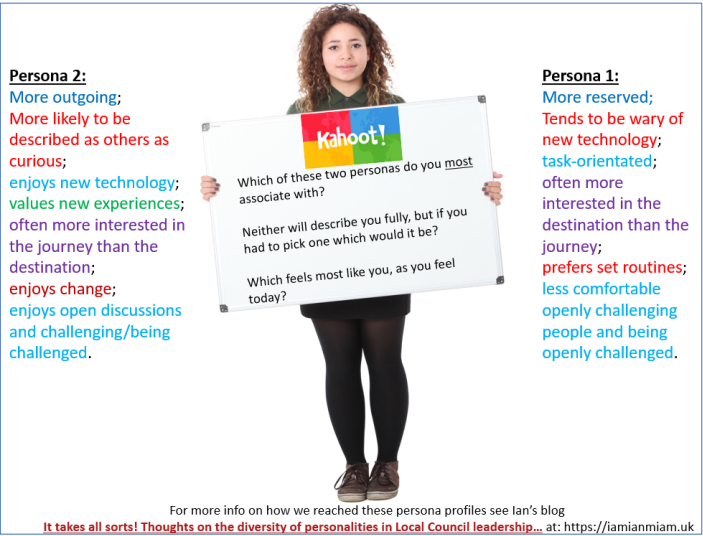
- It takes all sorts! As I waffled on about in my blog here, my early work with a small group of Clerks identified that there are some distinct persona types in our profession. This working hypothesis was further validated at the ‘What’s the Problem?’ workshop where participants were split 41%:59% in identifying more closely with a more reserved, task-orientated ‘persona 1’ type (41%) or a more outgoing, curious ‘persona 2’ type (see image below). We need to be careful about drawing too many conclusions from these findings as this is a clumsy tool, however it is certainly true to say that we are most certainly not a homogeneous flock of clone Clerks and that we should be wary of any potential solutions that suggest a ‘one size fits all’ approach.
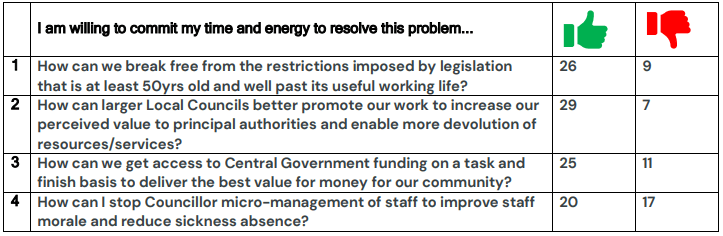
- We’ve chosen 4 problems to take forward! Colleagues who attended the workshop considered a long-list of 9 ‘problem statements’ and through group discussions they whittled the 9 down to a top 4 to be taken forward into the ‘Ideation’ and ‘Prototyping’ phases. The 4 top problems are: 1. How can we break free from the restrictions imposed by legislation that is at least 50yrs old and well past its useful working life?; 2. How can larger Local Councils better promote our work to increase our perceived value to principal authorities and enable more devolution of resources/services?; 3. How can we get access to Central Government funding on a task and finish basis to deliver the best value for money for our community?; 4. How can I stop Councillor micro-management of staff to improve staff morale and reduce sickness absence?
- Clerks are motivated to take action! Perhaps the most surprising output from the workshop was quite how animated and motivated colleagues were about being being personally involved in taking these 4 problem statements forward towards solutions. Colleagues were asked to confirm whether they would personally commit their time and energy to resolve each problem, with the results as per the table below. This level of enthusiasm and engagement bodes well for the next phases of this project.
So, what happens next? It’s now up to us, Dear Reader, you and I, to stand up and answer this call to arms. I personally have committed to ‘lead’ a workstream on problem statement no1 and I will be calling colleagues together for an ‘Ideation’ session to this effect once the summer holidays are over.
But what about you? Which of the top 4 problem statements hold the most value for you? If there is one that you have a particular interest in then please do let me know and I’m happy to pull some people together to look at the other 3 priority statements.
I’ll be publishing an article about the next stages in the November ’22 edition of ‘The Clerk’ magazine and we’ll be continuing this work in another workshop at the SLCC Annual Conference in November ’22. And please, don’t wait until then to get involved. Reach out to me, or to other colleagues…put yourself forward and get involved in being part of the solution rather than just sitting and wallowing in the problems!
How about it? Why not drop me a line here and I’ll be in touch soon!


 Mornington Crescent: The Taunton variation
Leave a reply to Emma Coleman Cancel reply