
On 7th April 2022 a group of around 25 senior leaders from larger Local Councils in the UK will gather in central London to do something about a wicked problem that we all have a stake in.
The group has self-organised. Rising from a total population of around 8,800 precepting Local Councils in the UK we’re not democratically elected and we’re not claiming to be representative of any social, demographic or geographic dimensions of our professional community.
What we are is a group of colleagues who have a sense that some ‘things’ in our sector and profession aren’t quite how we’d like them to be and that some ‘things’ might be changed for the better. And so we’re going to do something about it. And the way we’re going to do it is going to stretch us a bit too!
Applying creative design thinking to solving problems
The situation that we find ourselves in is a classic ‘type III’ or ‘wicked’ problem. We’re not actually sure what the problem is, and we don’t yet know what the solution is. Is it about representation and lobbying? Relationships with NALC or SLCC? Networking? CPD? Technology? You could ask any one of us to give our perspective of the problem or ideas about what needs to change and you’d get a more-or-less coherent answer – but there’s no clear, shared, expressed consensus on this.

Wicked problems lend themselves to creative design solutions. So we’re using the Standford Design School design thinking model to frame our work together.
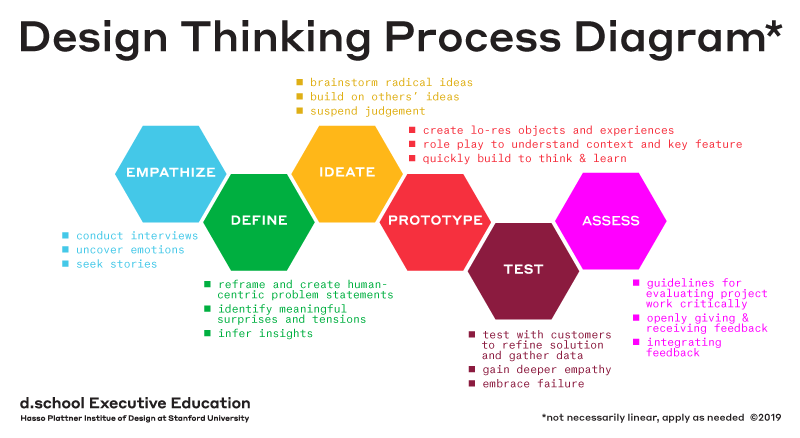
The workshop on 7th April will be focussed on the ‘Empathize’ and ‘Define’ phases of the Stanford process.
Empathize (or walking in each others moccasins)
Empathy is the centerpiece of the human-centered design process. The Empathize mode is really all about understanding how we are behaving and feeling when we are ‘doing the problem’. Unlike so many ‘real world’ situations where we tent to jump straight from ‘problem’ to ‘solution(s)’, for this project we are going to put in real effort to understand the way that we do things and why, our physical and emotional needs, how we think about world, and what is meaningful to us. We’re going to bump right up to our values and beliefs, what makes use tick, to get to the literal and metaphorical heart of the issue(s).
Two of the three workshop activities on 7th April are designed to do that empathy work. To help us to express our thoughts, feelings, behaviours and to experience those of others. To walk in each other’s moccassins, if only for a while.
Defining the problem (or problems – there may well be more than one point of view)
Having immersed ourselves in ‘the problem’ we’ll transition into the ‘definition’ phase. Here we will make use of ‘personas’ that represent different types of Clerks and how they are perceiving ‘the problem’. These personas may differ by longevity of experience, attitude to new technology, social gregariousness, process or outcome focus, or other such dimensions. And whatever those differences might be, our work is going to respect the differences and try to frame the problem from multiple perspectives so that the resulting solutions are as comprehensive as possible.
And then what?…
The intention of the 7th April workshop is to ‘out’ the issues and emerge with some clear ‘problem statements’. We may well start to come up with some ideas about solutions (we larger council Clerks/Chief Officers are, after all, all about solutions right?!) but we’re going to try to avoid the temptation to jump straight in to solution mode.
Instead, we’re going to spend a couple of months reflecting on the problem statements and checking them out with other people that were missing from the workshop.
And then, once we’ve had time to reflect, we’ll meet again to work on solutions…but that will be the focus of a whole new blog, so you’ll need to watch this space!
Oh, and in case you were wondering, the ‘walking in each others moccasins’ reference comes from a poem by a 19th-century American poet, preacher, suffragist, and temperance reformer Mary T. Latrap (1838-1895). I came across it quite a few years ago when I was completing a Master Practitioner course in NLP as we used the metaphor in terms of the use of empathy and appreciation of other people’s perspectives. I rather like it. Let me know if it resonates with you…
Judge Softly
Pray, don’t find fault with the man that limps,
Or stumbles along the road.
Unless you have worn the moccasins he wears,
Or stumbled beneath the same load.
There may be tears in his soles that hurt
Though hidden away from view.
The burden he bears placed on your back
May cause you to stumble and fall, too.
Don’t sneer at the man who is down today
Unless you have felt the same blow
That caused his fall or felt the shame
That only the fallen know.
You may be strong, but still the blows
That were his, unknown to you in the same way,
May cause you to stagger and fall, too.
Don’t be too harsh with the man that sins.
Or pelt him with words, or stone, or disdain.
Unless you are sure you have no sins of your own,
And it’s only wisdom and love that your heart contains.
For you know if the tempter’s voice
Should whisper as soft to you,
As it did to him when he went astray,
It might cause you to falter, too.
Just walk a mile in his moccasins
Before you abuse, criticize and accuse.
If just for one hour, you could find a way
To see through his eyes, instead of your own muse.
I believe you’d be surprised to see
That you’ve been blind and narrow-minded, even unkind.
There are people on reservations and in the ghettos
Who have so little hope, and too much worry on their minds.
Brother, there but for the grace of God go you and I.
Just for a moment, slip into his mind and traditions
And see the world through his spirit and eyes
Before you cast a stone or falsely judge his conditions.
Remember to walk a mile in his moccasins
And remember the lessons of humanity taught to you by your elders.
We will be known forever by the tracks we leave
In other people’s lives, our kindnesses and generosity.
Take the time to walk a mile in his moccasins.
by Mary T. Lathrap, 1895
 Mornington Crescent: The Taunton variation
Leave a reply to Hey, what’s the BIG idea? – Mornington Crescent: The Taunton variation Cancel reply