
In Professor Steven Griggs’ excellent article ‘Movers and Shakers: Reflections on the Leadership Challenges Facing Local Council Clerks’ (The Clerk, Vol 52, no1, January 2022) he suggests that Local Council Clerks are increasingly performing leadership through movement in both space and time. Steve’s article included a call-to-arms for further dialogue over what it is that Clerks ‘do when they do’ leadership.
In terms of movement in space, the article recognises our roles shifting between formal Council meetings, gathering with volunteers or members of the public, site visits, and he usefully also recognises the different contexts that those spaces represent – from the highly codified and formulated rules of a Council meeting, to more emergent contexts such as working on the ground with the local community, or dealing with a resident’s complaint face-to-face.
In terms of time, the paper identifies some of our actions with the all-to-familiar scenario of ‘firefighting’ that sees us ‘leaping in’ to resolve immediate, present time, issues. And Steve also recognises that temporal movement of ‘leaping ahead’ to work strategically, identifying and facilitating future possibilities and alternatives.
I thought it was interesting that Jonathan Bourne’s article in the same edition (‘Where is local democracy going? Guardians of the balance’, The Clerk, January 2022) touched on the concept of the ‘power’ and movement of the Clerk in a different way. Jonathan urged: ‘…As professional officers we must not abuse our position of knowledge and authority for a personal agenda…We need to need to keep fighting to maintain power for the advice we give, but never overstep that mark by allowing it to become self-serving.’
So, what is ‘power’? And how does power play a part in ‘what we do when we do’ those things that Steve and Jonathan discussed in their articles?
Traditionally our formal professional dialogues on ‘power’ tend to disappear down the techno-legal rabbit-hole of the sector. We talk about the ‘powers’ of the Council, the ‘general power of competence’, we worry about ultra vires decisions, and lament our Council’s ‘lack of power’ to address behaviours in light of the current Standards Regime debacle. Go through the threads on the SLCC Forum and so many of the discussions are based on these, or similar, perspectives of power.
But are any of those techno-legal perspectives on ‘power’ that are so pervasive in our professional forums really what the call for ‘responsible use of power’ (my words) by Jonathan was all about? Or the same ‘power’ that Steve suggests we might be exercising when we are ‘leaping in’ and ‘leaping ahead’ in our daily lives as Clerks?
The French philosopher Michel Foucault suggested that power is based on and makes use of knowledge. And just as knowledge is everywhere, power is everywhere – not because power embraces everything, but because power comes from everywhere. The neo-foucauldian view of power as decentralised and diffused in our daily realities is far from the centered view of power as something which sits at some ‘other place’, held in reserve by Governments or Big Business and then cascaded (or forced!) down through layers of bureaucracy, laws, rules or manipulation of market forces.
So, which is it? Does the power that we can wield as Clerks, the power that Jonathan urges use to use properly and Steve sees us using when we ‘do’ leadership by moving through space and time, really get handed down to us as distinct quanta via the Local Government Act 1972 (etc), or our Council’s Standing Orders (etc), or our Contracts of Employment, or other supposed mechanisms of power transference in our sector? Or, is the power that we have at our disposal really a more amorphous thing, an emergent quality that comes from our relationships in space and time with others around us and based on knowledge, something that is everywhere and nowhere?
Personally, I don’t see the two perspectives as being mutually exclusive. My experience is that both are true. Yes, the use of ‘power’ by us as Clerks is structurally enabled by a set of Standing Orders or a section of the Local Government Act, etc. These artefacts in the corridors of Clerkdom can give us legitimacy, and a raison d’être. In some ways then, perhaps it does makes sense to think of power in terms of quanta, of having a discreet and independent quality. And at the same time, without knowledge and without relationships with others those enabling artefacts and structures are just static exhibits in dusty corridors. And so it also makes sense to think of power as relational, amorphous, evasive, and a more (dare-I-say-it?) ‘political’ thing.
I suppose a pessimistic Clerk that takes the centralist view of power might feel ‘disempowered’ or even defiant – power is something that we don’t have because we haven’t had it transferred to us from above or someone/thing else has taken it from us, or power is something that we should resist, or even run away from, because it is being wielded by someone else due to their real (or perceived!) structural ‘Authority’ that is beyond our own.
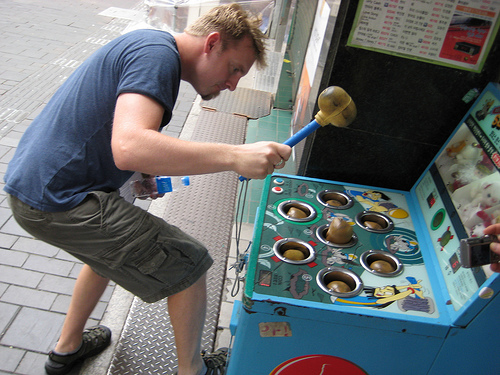
But a different pessimistic Clerk could take the decentralised view, and end up feeling ‘disempowered’ as the power they perceive themselves as being missing is so everywhere it is nowhere. Like a bar of soap in the bath, or a game of wac-a-mole, or the scary thing that lives under the bed, decentralised ‘everywhere’ power can be hard to grasp, it can appear from all over the place with very little predictability, and sometimes you really just want to pull the sheets up over your head and hope if doesn’t come for you during the night!


If we accept the proposal that the ‘power’ that we may wish to use when we ‘do’ Clerking does have amorphous, transient, relational qualities then this might mean that our sector’s approach to knowledge, and to the professional development of its Officers, might need to shift. I would suggest that we could usefully turn even more attention towards the relational elements of the role of Clerking, to move even more towards an adaptive and reflexive approach to Clerking that is based not only on techno-legal knowledge but on self-awareness and self-development. And it should embrace this as a core component of modern-day Clerking.
Let’s take a look at our CiLCA qualification – our benchmark for professional accreditation. I recently read a strap-line for CILCA that made the claim ‘A CiLCA qualified Clerk is an efficient and effective Clerk.’ I believe the five units currently covered by CiLCA are: Core roles in local council administration; Law and procedure for local councils; Finance for local councils; Management for local councils; and Community Engagement.
I’m wondering whether those techno-legal knowledge elements of the professional role of Clerking are perhaps essential components of an efficient and effective Clerk…but they are not sufficient. In its current form, the CilCA qualification is not enough. Passing CiLCA will not produce an efficient and effective Clerk.
Perhaps it’s time to add a sixth element to CiLCA, about understanding ourselves and the nature of our power and the ‘power relationships’ in our roles as Clerks? Not only what the law says about ‘Proper Officer’ or ‘RFO’ or whatever, but also on our individual personality types, how we interact with others with different personality types, and skills and tools for self-reflection and adaptiveness.
Perhaps in this way we can give ourselves a better chance of knowing what we do when we do what we do in our leadership roles as efficient and effective Clerks.
 Mornington Crescent: The Taunton variation
Leave a comment